|
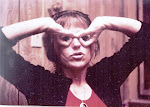
| Frances, my mother, age 18 |
The pastor introduced me to Martin Luther, the man, not the author of the catechism I had to memorize as a kid. Luther had an idea that people of faith are a paradox: They are simultaneously both sinner and saint, screw-ups who live in a state of grace. That concept helped me find forgiveness.
I’m thinking about saints, tarnished and otherwise, because this week’s host of Poetry Jam, NanU, wants us to write about the eve of something hallowed. [Poetry Jam, eve of holy somethings] Tuesday is All Saints Day, which actually means something spiritual to me today. I live to Google, and I found a nice little essay by a Methodist pastor, Rev. Dean Snyder, on huffingtonpost.com.
“If Easter is when Christianity celebrates the resurrection of Christ [Snyder writes], All Saints' is when Christianity celebrates the resurrection of the rest of us. The focus of Easter is the victory of Jesus over death and the grave. The focus of All Saints' is resurrection and life eternal for the rest of us.
“I think it can be an act of courage to believe in eternal life and to strive to live lives consistent with this belief. It takes courage to live as though our lives matter eternally -- even if they seem to us very ordinary, even frustrating and disappointing. It takes courage to believe that our lives matter beyond this lifetime, or even the earthly memory of it, when so much of what we do seems trivial and even pointless. It takes courage to choose to do the good and just thing in terms of eternity, rather than what is easiest, even when it will cost us something in the short-term and nobody will much notice or care anyway.
“It takes courage to believe that the lives of others are eternal — that each life we intersect and those we don't have eternal meaning and value and that we have a responsibility to each other that transcends the time, place and circumstances of our present lives.”
When I think of the “eve of something holy,” I think of the three nights I sat vigil with my dying mother. Both of us started out scared. Both us found courage. She’s one of those full-blooded saints now, no longer living a checkered life. This is the poem I wrote as she lay dying.
Your Dance of the Final Days
Your chest rises and falls rhythmically, I see
glancing at the narrow bed across the room.
It is anyone’s room, a blue sea of carpet,
a drawn window shade, but here is your
cedar chest, scarred with memories. Here
is your sewing cabinet, made by your father,
its varnish worn. Here am I, in your office
chair, slash of duct tape on its vinyl seat,
its squeaky, rusty wheels. I watch you
sleep, your labored breathing drowned
by the hum and hiss of oxygen, afraid to look
away. The bedclothes might stop rising
and you slip off, me unaware, intolerable
thought. I want to see you should you slide
from the bed and do a jig across the floor.
I never saw you dance in all these years
but there’s no telling what you’ll do.
You have surprised us all before.
You surprise me now with your tenacity,
my skeletal lioness, chomping the neck
of the very last giraffe.