Protected by Copyscape Web Copyright Protection Software
Showing posts with label Poetry Jam. Show all posts

Tuesday, February 14, 2012

Love Is a Miracle


A miracle is in progress out in the yard. Despite freezing nights, despite drought in our part of the country, buds burgeon on plants that winter stripped of every living thing. The life force is stronger than all the adversity this winter has thrown at it.

Another miracle: I'm at home with the man I love on our 20th Valentine's Day. We two, who have six marriages between us, have survived everything those 20 years threw at us, in part because No Matter What we kept the promise we made all those years ago: not to run, not to stuff things down, and not to lie to each other ~ not a very elegant promise, but an effective one for us.

Poetry Jam focuses on miracles this week. The past year has been my time of learning to see the small miracles that happen in everyday life and be grateful for them.


You Could Use a Cheap Miracle


“The quality of my life is so poor –
no money,” you said, counting the obligations that

Loom, while penniless you worry –
tell, instead, the last miracle you saw, and what

It cost you. Did you view it from a window
? or did that small fire flare in your chest when

In the half-dark he reached for you even
in his sleep
? The whimper of thanksgiving

Is as good as a hymn
but easily missed – better than meat

After days without food
when your soul is starving.


Saturday, February 11, 2012

Hot and Spicy


Boredom and complacency spell the death of everything, from marriage to political activism. When I saw the prompt for this week’s Poetry Jam, to write a poem about spices, I thought of the restaurant menu I read last week while doing a magazine assignment. How do you liven up your life?


Chili-Dusted Potatoes

Wake us up from our slumber with hot spices
We need something disturbing to crack the shell
of lethargy, and the mouth is such a tender place
all moist and plump and pliable, doughy kisses
and pabulum. Explode

Our placid pigeonholed lives, pull out all
the glottal stops that swallowed dreams
like gulping fish. Wake us with a howitzer
of warring words, divisive tongues
Spur us into life again


Friday, January 27, 2012

Wildcat Experiment Continues


(Today's update below)

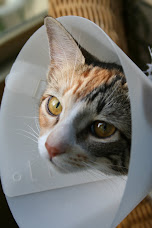
(Tuesday, 1/24/12) I keep my hands off feral cats unless they’re nursing kittens who appear to be abandoned. I’m a sucker for those, having adopted five ourselves over the years and placed a few others elsewhere.

But my heart’s gone out to a long-haired cat who adopted our front shrubbery last year. It doesn’t behave like a feral tom. It behaves like a frightened abandoned pet. I kept hands-off for months, but the temps have dropped to low twenties/high teens, and the cat has made a tiny nest in the nook of the fireplace wall this past month. It’s right outside my sunroom. The first rains came last weekend.

At dusk last night I saw it curled up there, and I swear I saw it shivering. The sight plagued me. Early this morning while nesting in my warm bed, I dreamed up a toaster bed for this cat. It involves heavy-duty aluminum foil over a wire hut and under its nest of leaves (carefully saved and replaced while wearing gloves), supplemented with hanks of Spanish moss under and over for insulation. I put out food as well to make this hut enticing. I think it might be too tall to reflect any heat, but better than nothing perhaps? We’ll see if the cat welcomes my interference. I let you know.

Day One: Cat Checks Bed, Says Yes to the Food, No to the Bed

Night Two: Food’s gone again. Cat slept under my car, even though I made my husband burn the last of our wood in the fireplace. This morning I’m getting sneaky. Put two morsels in food bowl but a whole handful on two leaves inside the hut. More firewood’s on order. Mark the Walking Man has offered construction advice in his comment. I shall refine the bed per his suggestions, since I don't know shit, really, about the reflective properties of inward-facing aluminum foil.

Third Day: (Investigator's notebook)

Someone was here during the night: evidence
leaf out of place
contents of offering plate, gone
footprints on moss carpet (maybe)


Nothing proves
who: any hungry nightcrawler
might have fallen joyfully upon the altar


Possible suspects: recently noted
gray squirrel w/ high-plumed tail, sniffing fence
tomcat, B&W cruising northbound
27 cedar waxwings casing the place
skunk on road (dead)


Poetry Jam requests poems of the senses this week, so I’ve adopted the feral cat’s view of this ridiculous experiment. Find more sensual stuff here.

Wild Cat Haiku

Whoever you are
What have you done to my nest?
It smells like a trap

I see what you made
That foreign thing is a mouth
I don’t enter mouths

Food magnet draws me
Crackling danger sounds inside
Ears laid low, I flee

Catastrophic mess!
Suspicious hair stands on end
I watch, quiver, wait

Then attack the food
Place stinks but how dear the meal
It tastes like more, please

Wednesday, January 18, 2012

Something’s Amuck in Paradise


My first brilliant thought this morning: Something’s amuck in paradise. No coffee. No newspaper. And the phone rings, bearing wild anxiety from a woman I sponsor.

Mr. Coffee steams like mad to produce a thimbleful of lukewarm coffee. A hike into the colder-than-crap outdoors produces no newspaper. Both are essentials to awaken my bleary brain and allow me to produce speech. So I’m pretty pathetic when my frantic friend calls about her new medical insurance bill.

I tell my friend to hit her knees, then unearth the old percolator from the garage’s camping gear and crack open my morning meditation book, which discusses faith overcoming all adverse conditions.

That’s when my husband enters, bearing a hot latte and the newly arrived newspaper.

My Higher Power’s sense of humor is busy on a chaotic Wednesday morning.

The phone rings again: A service technician wants to postpone today’s scheduled maintenance so he can fix the heaters of those who are without heat on this 21-degree morning. Again I’m reminded that things could always be worse. I could be flat-broke like the woman I sponsor. I could be both broke and frozen too like others whose heaters aren’t working. I could be headed for chemotherapy this afternoon, like my own AA sponsor, or for radiation, like a man my hubby sponsors.

I shouldn’t ever take my first brilliant thoughts seriously. I can be as sour as I want to, or as joyful, because I’m free to start my day over again any time I like. By returning to a position of gratitude, by remembering to be thankful for what I have, I can make my home a better place in which to greet the world.

Today I have no legitimate complaints, as a man used to say in the early AA meetings I sat through 22 years ago. My humorous Higher Power converts even trivial adverse conditions into teaching moments about the value of faith. There’s nothing at all amuck in paradise today.


Scenes of Winter

The catfight wind yowls
churning the shrubbery
scrabbling over fences
staggers even the stoutest trees.

The stalk of a budded lily
arrow dipped in blood
aimed at heaven
quivers in its invisible bow.

The moon’s white opal
glows on blue velvet
rainswept with diamonds
swallowed by clouds.

Inside your love
is a woolly blanket
abrasively delicious
on a bitter night.


What reasons do you have to be grateful today?
Over at Poetry Jam people are pondering the power of home.

Wednesday, January 11, 2012

Laugh in the Face of Everything

Farm couple shares a laugh in 1940


Got no crop last year
Lived off the fat of the land
Ma says I taste good

On that new kwi-zine
Ma feasted. I fasted. Look:
Now I need new pants

Crop came in this year
We’re living high on the hog
Food’s good. Love’s better.


This old photograph reminds me that laughter's one of strongest medicines on earth. While 1940 wasn't a banner year in history, the farming couple from Connecticut still enjoys a joke, maybe made by the husband as he hoists his pants.

A sense of humor helps maintain my equilibrium as the world churns around me. I suffer from a tendency for catastrophic thinking, but there’s an antidote: a dose of hilarity. Mentors showed me I can improve my perspective whenever I want to, no matter what’s on deck, by celebrating life’s absurdities. I'm thankful for the power of laughter.

See what the photo inspires in others over at the Poetry Jam.

Photo credit:
Public Domain Photograph from the Farm Security Administration – Office of War Information Photograph Collection in the Library of Congress; Jack Delano, photographer.

Thursday, January 5, 2012

Sun Lovers

In winter I think of the sun because it’s fickle. Fickle things annoy me. I need that sun, need its vitamin D and its hopefulness. When it’s shining, I’m thankful. Even if it is the color of watered down nonfat milk, it’s got power.


Happiness is a sparkling strand of spider’s silk
diamonds of dewdrops
in the rising sun

Happiness is finding in the rose’s thorny mass
a pair of praying hands
open to receive the winter sun

Happiness is waking beside a new beloved
surprised your body delivered the verdict
your heart hoped for
A new sun smiles


Telling a tale in exactly 55 words is the G-Man's Flash Friday challenge. Check it out here.
Color is what poets are jamming about this week at Poetry Jam. Find crayons here.

Thursday, December 29, 2011

An End To It

Music ended a decades-long writer’s block for me. What I wrote that night five years ago is not a great poem, but it was an ice breaker. I’ve learned that making a beginning is the key to everything. And with the Poetry Jam’s prompt this week being music, and with the year ending, this subject has special meaning for me. I’ll share the song that ended the long silence of poetry for me, “Tu Quieres Volver” by Sarah Brightman.

To get the gist of what happened to me, you might listen to the song first, then read the poem that arose from it. I’ve posted the poem before, so if it sounds familiar, please just enjoy Sarah singing.


Look at It This Way


this is you
this is her
twin threads twining in space
up and up andupandup
sinuous as snakes
the dance of the double helix
making life grow high

this is you
this is her
round notes soaring
high and round as the moon
in a purple sky
full of light a bird in flight
a waltz of wind and feather
mounting waves of air

this is you
this is her
a swelling-rising-rearing-
crashing wave
shatters on the sand
and the sand soothes
calms and suckles
a soft sighing washing smooth
the rough edges and the fury

this is you
this is her
strong arms gripping
across the precipice of loneliness
strong limbs bowing with the wind
strong lines moored in heavy seas
above all holding fast
in the face of all storms


Wednesday, December 14, 2011

Occupy THIS


An amazing thing happened today. My husband said he thinks a water pipe is leaking in an interior wall, and he pointed out his evidence. (This man has been ordered by our plumber to refrain from “fixing” things himself.) I studied hubby’s evidence, and it didn’t look like evidence to me.

But my head leaped straight into fear. Another expense! More bad news! Another explosion in our tight budget! My head freaked out so thoroughly, it hurled me right into an anxiety attack.

I was mauled by the sense of impending doom, pummeled by the “What Ifs” and the “Oh Nos”! Right off the top of my head, I conceived of 1,000 other things that could go wrong, from the personal to the global level. Then I went straight to the place where I can kneel in prayer, did that, jumped up and went to an AA meeting. Came home, breathed, called my sponsor. Was instructed to breathe some more.

I haven’t had an attack of fear like that in a long time. In recovery I’ve learned how to redirect the kind of catastrophic thinking that used to plague me. I have tools that work. Hours later, I’m still shaky, but my feet are planted firmly in the present, where all my needs are taken care of. After dinner, I’ll go set up a church hall for an AA meeting, where I know I’ll hear the music of faith from people who have been transformed.

I’m grateful that I can occupy my mind with what’s good, here and now.


Too Preoccupied with Birds to Notice

Sometimes when my mind is full of dire news
swollen by streams of the world’s sorrows,
I hunt for robins.

A pair of them live like lords on my land,
where they feast on a cornucopia of insects
leading busy lives in centuries of mulch.
The world’s calamitous chatter fades,
irrelevant, as the robins strut and pluck
the strands of their living harp.

Monday, December 5, 2011

Oh, Boy! Deep Freeze


The killing frosts have hit us here on the central coast of California. Our nights are down in the 25-degree zone that kills all the tender growing things in the garden. Tomatoes that remained on the vine are popsicles in the mornings, turning to paste after sun-up. My beautiful dahlias are now brown stalks of mush. Normally, this would depress me: Winter is coming, alack! alas! But something’s different this year. I don’t feel like Eeyore.

In fact, I feel pretty interested in life. I’m checking out this garden scenery….


…and I’m thinking, I betcha that puppy has viable seeds in it! I’m looking at this dahlia….


…and I’m thinking, there’s a gift for me in there! I suspect a praying mantis laid an egg case on one of those branches, and I’m going to find it and save it when I cut that dahlia back.

Several things are different in my life this year. I’ve been working with a new AA sponsor, and she’s had a big impact on my outlook. We’ve been studying faith and gratitude, and I’m reading Leo Tolstoy’s The Kingdom of God Is Within You. She also was diagnosed last month with stage-four lung cancer. Now we have our weekly talks while she’s getting her chemo treatment. I’m not scared about her future; I’m blessed by her life.


Maybe it’s the added vitamin D in my diet. I’ve taken substantial D-3 since a deficiency was diagnosed back in March. My immune system is vastly stronger than it was last year, with its serial pneumonia and relentless infections. There’s a correlation, too, between major depression and D deficiency. Maybe the converse is true as well, and I’m nutritionally better equipped. Who knows? Is it God or vitamin D? Who cares? Life is good.


The deep freeze around here has sent the sap earthward, but my spirit lifts upward. Tolstoy has affected me greatly, a gift from out of the blue. I caught the tail end of The Last Station a while back, and it sent me on a research run to learn more about his "spiritual anarchy." His study The Gospel in Brief held me spellbound. When the word “deep” was offered this week as a prompt on the Poetry Jam blog, I thought of this poem, written a month ago at a café while waiting for a lunch date who never showed.


The Water Walker


Faith made Peter climb out of the boat
and walk on water for a while until
he remembered people can’t do that
and then he sank. I understand
his sinking; I too have sunk
into the impossible and had to stroke
for shore, arising on reality
drenched and choking.

It’s the faith I want to summon in the boat
that mesmerizes me: to see the liquid
which I know cannot support me, yet
to trust in God’s incredible command
that I be more than bone and flesh
tethered to physics and the imagined
certainty of all my limitations.


Sunday, November 27, 2011

The Bravest Thing I've Ever Done


Getting sober is the bravest thing I’ve ever done. To look the world straight in the eye, without self-medicating first, requires this alcoholic to dig deep for the courage that many people seem to come by naturally. And she has to keep digging too, to keep up with the adventures of being human.

The artwork I’m using today is an illustration by Gustave Doré in the 1866 version of John Milton's Paradise Lost. “Satan rises from the burning lake” illustrates what Milton calls Lucifer’s “courage never to submit or yield.” The piece also has been used in reference to one of my all-time favorite poems, “Ulysses” by Alfred, Lord Tennyson, which ends with these wonderful lines:

Tho’ much is taken, much abides; and tho’
We are not now that strength which in old days
Moved earth and heaven; that which we are, we are;
One equal temper of heroic hearts,
Made weak by time and fate, but strong in will
To strive, to seek, to find, and not to yield.
I memorized “Ulysses” for a college speech class, drawn to its celebration of the enduring adventuresome spirit. I never have read Paradise Lost, and I find the Satan connection a little icky. But the prompt for this week’s Poetry Jam asked poets to write something inspired by Paradise Lost, John Milton, or Gustave Doré, and my research led me to my beloved “Ulysses” via the aforementioned Lucifer link.

Courage is the thing that gets me excited. I’ve had to find some. I’ve had to learn how to endure when life goes sideways. I’ve had to learn self-discipline, the courageous act of refusing to yield to my own wild impulses, which would have me flee from uncomfortable circumstances. I’ve had to plumb my inner resources when shit hit the fan, and when I came up empty, I’ve had to discover that God’s grace is sufficient on any given day.

All of which is a boatload of verbiage to introduce a very short poem ~ 160 characters, to be exact, counting the spaces. Visit other poets monkeying around with ultra-shorts at Monkey Man’s place here, or jamming with Milton here.

Here is my extremely short epic poem:

Without a shield, I face my fears
Weak, unarmed, I will not yield
As the smoke of battle clears
I’m still standing on the field
By your cheers my wounds are healed!

Saturday, November 19, 2011

Learning Endurance

Photograph by Dorthea Lange, 1936

Great moments in history on this date: Goodbye, Ford Edsel; Hello again, Moon (second Apollo landing); and Lincoln's Gettysburg Address
 "We can not hallow -- this ground. The brave men, living and dead, who struggled here, have consecrated it, far above our poor power to add or detract. ... It is rather for us to be here dedicated to the great task remaining before us ... that these dead shall not have died in vain -- that this nation, under God, shall have a new birth of freedom -- and that government of the people, by the people, for the people, shall not perish from the earth."


I wonder if survivors of the Great Depression and the Midwest Dust Bowl bequeath a primal-memory gene to some of their kids… some inheritable, shady sense of having endured the catastrophic and standing ready to endure it again.

I owe my life to the Depression and the Dust Bowl (proof I should remember next time I question whether ill winds really do blow in some good). On both sides, my parents’ families were migrant workers in the 1930s, one from Oklahoma, one from Montana, who came together in a small California town, eventually creating me. It’s my birthday this week, and I’m pondering my beginnings.

The photo I’m using with this post was taken by Dorthea Lange in 1936 just down the road from where I was born. It shows a woman named Florence Thompson with three of her seven children, at a migrant camp near the pea fields (which still are grown there). Lange easily could have photographed one of my grandmothers with my father or mother in tow, heading for their rendezvous with destiny (sorry).

Besides my own family history (discussed around dining tables all my life), I’ve also interviewed many Great Depression and WWII survivors in my magazine work… so maybe it’s just familiarity with their generations that gives me a sense of kinship, rather than some unconscious primal memory of endurance as a way of life. What I know deep in my bones, whether it has come via genetic code or education, is that human beings are capable of suffering great loss and misery with dignity, without complaint, and with a majestic patience. That character is something I want in my life.

Lange’s “Migrant Mother” is the poetry prompt this week at Poetry Jam, where you’ll find other interpretations of that great photo. Here’s mine.


Good Norwegian Stock

My grandfather’s ways sprout from my fingers
like seeds lifting their round heads
out of black earth under a broad blue sky.
Skydotter, he called me, with mirth in his eye:
the Norwegian name for rain-laden clouds.
And daughter I am, a loaded ship of cloud
in an ocean of sky, sailing the big Plain
sowing grain in my wake.

In his time,
Grandfather paused to tip back his hat
and watch the wild geese vee southward
as clouds lowered for winter’s long march.
Eyes watering with Montana cold,
well-worn flannel warming his neck,
he spared a moment in endless treks
from house to barn to fields and back
to honor the enduring geometry of geese.

The time came
when he bowed his head before dry fields
that refused the seed and sealed the land
against the grain. He surrendered
the farm to the drought-battered Plain
and turned westward, where his hands
skilled in the nurture of growing things
became carpenter’s hands, sawing trees
into usefulness as cupboards and houses,
though he preferred them wild.

Undeterred,
he dug his hands in the unfriendly dirt
behind the small place in the new country,
with aging patience coaxing from it
fields of freesias and clouds of lilac,
roses bowing heads heavy with buds
above a sea of tulips. Tomatoes marched
through rainless summers in his garden
guarded with small offerings of water
and waves of corn ripened by the fence.

I grew up in a field of plenty, cultivated
by a grandfather still wearing the old felt hat.
I, his sky daughter, wore his hat with pride
the day I stood as the heavy sky burst,
my dirty hands outstretched to catch the rain
falling, falling, on the young strong grain.


Dorthea Lange’s photo is reproduced from The Commons on Flickr, an awesome site of worldwide photography in the public domain, with use restricted to personal, educational or research purposes.)

Sunday, November 13, 2011

Lightness of Being

each day
you wage a thousand wars
to preserve the nation of yourself

to defend your freedom
to lie down in your bed

you are a good country
responsible, alert
so you

marshal your resources
govern your thoughts
safeguard your borders
discipline your troops

you exercise vigilance
moment by moment
in every transaction
every choice, every plan
no wonder you’re weary
of fighting the war

stop now
and rest
notice light plays
in a window
it wanders
and dances
through wars
without ceasing


Prompted by the Poetry Jam, "Photograph a still life and write about it."

Saturday, November 5, 2011

Gimme an Asteroid, Sunny-side Up


Weird stuff to ponder on a weekend morning: What plans should we make for our appointment with an asteroid Tuesday afternoon?

I have a freelance writing deadline that day: Will it matter if I make it? The looming asteroid stimulates Hamlet questions. Is it nobler to spend the weekend nose-to-grindstone, honoring my commitment in hopes of a future? Or should I shine it on? Shall I take arms against a sea of oppressors and their outrageous fortunes, go Occupy somewhere, or should I go to the movies?

Seriously, folks, I’m going to see Puss In Boots before I shuffle off this mortal coil.

Now, after that peek through a window in my silly mind, here’s another, hot off the press. It was provoked by this week’s Poetry Jam prompt (more sneak peeks here).


Window


What hides from the outside world
behind her face festooned with flowers
might be the prick of the poisoned rose
or worse
the clatter of cloven hooves
as her demons cook their dinner
with this day’s torments

You never know
what gingham curtains veil
what beast exhales
behind that convivial cloak
willing you to leave
frightened by the light
you stand in so bravely


Saturday, September 17, 2011

The Female Mystique


After a few days of wallowing in computer-induced depression (see below), I was given three gifts in the past three days: 1) I found a solution for configuring my email [perseverance pays off!); 2) I worked with an AA newcomer, which reminded me of the life-shifting grace of the program that is central to my existence; and 3) I gave the best poetry reading of my life. My own words seemed to be full of power that evening, judging by the exuberant response of the audience and the raves of my husband, a man-cave kind of guy. Afterward, I sat in the dark on my patio, glowing like a lightning bug, pouring out my gratitude to the God of my understanding, who transformed me from a suicidal drunk into a woman who inhabits her skin with joy.
~~~~
(Commercial break: The following poem is based on the photo above, courtesy of Ainsley Allmark at Dolphin Visions. Visit Poetry Jam for other poems inspired by Allmark's photography.


The Sea Is a Woman

The sea is a woman who bears children
and then must feed them with what food
her kitchen holds, beans and onions
when times are hard, elaborate spreads
when the larder’s rich, and always after
scrubs the dishes.
Her governor, the moon, a bureaucrat,
ordains her tidal blood without concern
for inconvenience, but she’s resigned,
even sees the benefits, to child-rearing,
say, or affirmation of her womanhood,
in the ebb and flow.
It’s the tax man who exacts the heavy toll
of living, that hungry sun who sucks
her shekels, whose daily glare demands
his due. What comes in, soon goes out,
the nest egg evaporates, but she grimly
pays the price.

Ferociously she loves the land, her mate,
but he is forever leaving her behind.
In the moments when she has him near,
something in her surges, and fervently
she licks his skin, his neck, his thighs,
his earthy taste like honey on her tongue.
They kiss on the sand; she shatters
on the rocks of his imperturbable
soul. She takes the small gifts he offers
and savors them, rolling them around
in her mouth like unbreakable promises
that he will always, always return.


Sunday, September 4, 2011

My Curious Guest, Revealed

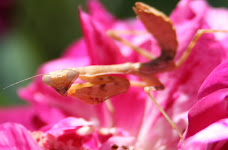
It was pure serendipity that I found this creature tucked into the roses Saturday morning. It looked at first like a dry curled leaf, and I'm not sure why I moved in for a closer view. Picking dead leaves wasn't on my agenda; I was picking dahlias. I like to think that God was nudging me so I could enjoy His strange surprise. Last night I queried Google images and learned that my beautiful guest is a sphinx moth that goes by the name Eumorpha achemon.


The moth has a fighter jet's lines. I learned that sphinx moths are some of the fastest flying insects, and some can fly over 30 mph. The achemon has a wingspan of about 3.5 inches, about the width of my palm, and it flies at night. One website said it is rarely seen, which reinforced my sense of the serendipity of our meeting. Achemon feeds on nectar, especially petunias, which I don’t have. Maybe that's why it was gone this morning.

In Greek mythology, Achemon and his brother Basalas were a pair of mischief-making ancient spirits, who once stole the weapons of Heracles. He punished them by tying their feet to his club and slinging it over his shoulder, marching off with them hanging upside down, facing backwards. From that perspective, the brothers beheld the sight of Heracles' bare butt and burst into laughter, and when Heracles demanded to know what they were laughing at, he cracked up too and let them go.

I have no idea why the Achemon myth inspired the gentleman who named this moth in the 1700s. But the Poetry Jam requests a humorous poem this week, and the Achemon myth inspired this haiku:

Two mischief makers
spy Hercules’s godly ass:
Divine heroic crack-up.

I like to turn events like this into life lessons, so I remind myself: You never know what might cross your path today. Might be some little miracle tucked in there. Tunnel vision will blind you to it, so be observant!


Sunday, August 21, 2011

How I Try to Save Polar Bears


I'm regularly assigned by a local magazine publisher to write of things I know nothing about. Thank God for Google and Wikipedia.

I know next to nothing about polar bears, except what I read in newspapers and National Geographic. They tell me it won’t be long before two-thirds of the world’s polar bears die off because of the shrinking Arctic ice. Within 40 years the bears will have lost nearly half of the range they need to live in.

Figures like that depress the crap out of me. One of my assignments was to uncover small things that helpless, depressed people like myself can do to reduce global warming. Here’s one factoid I found, although I don't remember its source: If every U.S. family replaced one regular light bulb with a fluorescent one, we’d eliminate 90 billion pounds of greenhouse gases, the same as taking 7.5 million cars off the road. We replaced three light bulbs. It may be pathetic, such baby steps. But better baby steps than no steps at all.

For this week's Poetry Jam, we are asked for poems that attempt to make a difference. I'd like to make a difference for the polar bears.

Song of the Arctic

The Arctic is screaming
a scientist said
The blanket of ice
on top of the earth
is fraying so fast
some summer soon
the walrus and wolf
the white bear and seal
will have no ice
to wander

They are not walkers on water.
They are not Christ.
They cannot redeem the world.
They cannot make ice.

We read this in the paper
sipping lattes on Sunday
take note for a moment
like a twinge in a tooth
It passes and we forget
we are a bowling ball
hurtling down the lane
at a bevy of pins
we soon will shatter
and they are living beings
screaming in the Arctic


Sunday, August 14, 2011

August Night


Twilight falls on an August evening. A sprinkler waters a neighbor's lawn with a cha cha cha shewwww cha cha cha shewwww. A thousand crickets begin their orchestra in the darkened park.

I have to go put on long pants and slippers, the air is so unusually cool. A quick tour of the garden earlier, after we came home from a friend's dinner party, shows some of the dahlia buds have begun breaking into flower on plants that haven't yet bloomed. It's been a strange summer in this usually hot neck of the woods. The garden looks like a midsummer garden, vigorous and full of life.

Four years ago, in the dog days of summer, I sat on a bench in the park next to my house and wrote a poem about the sad state of the garden. It was a different kind of August then, the unrelenting heat speeding the cycle of life and death.

The Poetry Jam prompt for Monday is "evening," and I thought of that poem. It surprises me how great the sense of loss is, when life cycle winds down and plants turn to the production of seed. Seed is a promise of resurrection, but it doesn't arouse hope in me in August. In early spring, yes. In August, seed is an ending, a reason to lament.

The Garden of Dry Bones

The long warm light of an August evening
strikes the black petals of a blown red rose.
Leaves of the dahlias droop; flowers rot
where they have fallen.
Dust drifts in the still yellow air.
Even the ground is tired.

All the bright blooms have faded.
In wild abandon, the sunflowers
throw back their heads, dripping seed.
The herbs, pungent and robust a month ago,
spend their straggling selves on seed.
Seed is the coin of late summer.

Seeds, and more seeds, fall from the
carcasses of flowers, like dry bones.
The golden light of August slants
through the graveyard of the garden.
Bereft, the gardener picks dry leaves
from the hollyhock.

In the waning light of August
the earth falls silent slowly,
the fading note of a violin.
Onward plows the cycle.
Downward bows the rose.
This is how love leaves you
one dead flower at a time.

Friday, August 5, 2011

Set Free


My mother died a year ago this week. I’ve commemorated the final four days I spent with her in several different ways, alone and in the company of friends and family, starting with flowers on her grave. Her headstone makes me smile; it’s a note she jotted on her way home, ending with her initials.

And then there’s the odd little poem that came to me on Wednesday. It’s an elegy of sorts, for this week’s Poetry Jam prompt, and a Friday Flash 55. May your weekend bless you.

Freedom, In Other Words


To celebrate my mother’s death
one year ago today
I went to a shop and tried on
tight dresses
imagining myself
reading poems
to Pablo Neruda in his dotage
wondering
would he want me
and my poems
to stay the night
if I were
wearing this?
Something about my mother
being gone
has turned me
loose.

Sunday, July 31, 2011

I Am All Feet


Of all the kooky things a person could start with on a Saturday morning, I started my day with a study of metric verse: ta TUM! It was an accident!

I just wanted to write a short poem in iambic pentameter for our Poetry Jam this week. For some reason, I unearthed my copy of “The Complete Rhyming Dictionary” from 1936 and promptly got caught up in rondelets and dactyls, tercets and feet. Its editor, Clement Wood, writes wonderful essays about everything you could ever want to know about rhyming poetry. Got so enchanted, I didn’t write my little poem until late in the evening.

It reminded me of the time I wanted to fact-check an interview I did with a WWII veteran, just to double-check my dates on the Allied march into Germany. I ended up reading about the Third Army under Gen. Patton for two whole days, fascinated. And I was on a deadline!

Anyway, the Poetry Jam assignment is to write a poem about being 67 years old. Hostess Dana had her reasons for this (find them here). She also said to write poetry outside of our standard operating procedure. So I chose a form foreign to me: the rhyme royal, a seven-line stanza out of the Middle Ages, used by Geoffrey Chaucer. I haven’t looked at his stuff since college. It might as well be Greek. It has five pairs of iambic feet: ta TUM ta TUM ta TUM ta TUM ta TUM. The rhyme scheme is a-b-a-b-b-c-c.

Writing the poem was kind of like building a kite: It proved harder than I thought it would be. So I took a break or two and photographed the flowers I put on my desk Saturday morning. And here is my poetical account of being 67, in a stanza pattern way older than that:

The Next-Door Neighbor

We call her “She,” the woman living here.
We don’t know her past or age, let alone
her name, only that She’s terribly queer

about her garden, so much overgrown
She vanishes there. But with crooning tone

we can hear her chattering to her plants—
and they reply! With great exuberance!

Sunday, July 17, 2011

Nocturne


Insomnia is one of the loneliest disorders. At 3 a.m., it’s just you and your head while the world seems peacefully sleeping, your sleeplessness an affront to the natural order. It might be nice if somewhere in my little berg there were a 3 a.m. insomniac support group, with low lighting and hot milky chai, water fountain, futon sofas, soft music, dark rooms down the hall with futons to lie down on should sleep seem possible.

One of my complaints about having insomnia is the ever-present sense of hope that sleep lies around the next bend of the clock. That hope prevents me from saying screw it, turning on lights, electronic entertainment devices, writing the next great American poem. Instead I hopefully practice “good sleep hygiene,” foregoing the blue computer screen, the blue television light, both known to stimulate the brain. The only light I turn on in desperation for the company at least of a rather boring book is the lamp by a chair.

I can’t take prescription drugs for sleep or the anxiety produced by not sleeping, because my body recognizes the drug and wants more of it, not a good situation for someone who cherishes her sobriety. For years I used tryptophan, a reliable friend until it was removed from the market early in the ’90s. Then it was Tylenol PM, until it stopped working. Then the psychiatrists introduced me to Seroquel, an anti-psychotic and powerful sleep-inducer. It added 50 pounds to my small frame and raised my cholesterol sky-high, and after five years, I severed my ties to it. From January to April this year, I hardly slept at night despite a pharmacopeia of herbs promising slumber. It was a very hard season.

Finally, after lots of research on the web and consultation with my psychiatrist, we changed my depression medication and I started taking mirtazapine, a tetracyclic anti-depressant with few health-threatening side effects. It’s taken almost three months to adjust to its soporific effects. I felt like sleeping all the time, and often simply did. At last, now I can stay awake all day and do the things that a normal person does, and usually I can sleep at night. In my gratitude journal, begun a few months ago at the suggestion of a new AA sponsor, there are lots of references to the joy of sleep, even for an abundance of it.

This week’s Poetry Jam has us humming the tune of insomnia (or, alternatively, odd modes of dress [hm]). Poets have produced lots of good work about insomnia, which is the companion of many people with fine minds. I have a number of poems referring to sleeplessness myself. But here’s a new one.


Night Sight

The moon is a white eye
cloud-lidded
in a broad blue face
and it peers over the humpbacked hill,
over the giant supine silhouette
of some black, some dozing beast.

I stare right back at it, fierce
as an itch that won’t be quelled.
My house is full of people
tucked in dark rooms.
No one knows
I crouch here on the couch
eyeballing the moon.

Everyone sleeps, safe, secure
like they were last summer
while our old mother and I
fought for her death,
three nights and days that bled
into each other. Tonight
I learn how much I gave her
simply being
awake. The moon must know.

Black and blue, the bruised sky
hours later cracks open
slowly for the sun, still
just a thought, or a memory below
that humpbacked hill, coming to heal
those bruises.